

Introduction
Chiang Mai’s international schools in 2026 serve approximately 4,500-5,200 expatriate and Thai-national students across 12+ accredited institutions, offering four primary curriculum pathways (British IGCSE/A-levels, American AP, IB Continuum, and bilingual models) with annual tuition ranging THB 180,000-850,000 depending on accreditation tier and grade level (International Schools of Thailand Annual Report 2026). Thailand’s Board of Investment reports 23% YoY growth in education visa applications for Northern Thailand (2025-2026), driven by remote work relocation, retirement migration, and families seeking alternatives to Bangkok’s congestion and Singapore’s costs, yet 40% of relocating parents report insufficient pre-arrival research on curriculum compatibility, accreditation recognition, and total cost of ownership beyond base tuition (Expat Insider Education Survey 2026).
Critical decision gap: Marketing materials emphasize campus facilities and university placements while obscuring curriculum transition risks (British→American credit loss, IB availability by grade), hidden costs (capital levies THB 50,000-200,000, transport THB 35,000-80,000/year, EAL support THB 40,000-120,000), and burning season impacts (February-April AQI 150-300+ affecting outdoor activities and respiratory health), complexities top SERP guides (International Schools Thailand, Expat Focus averaging 1,200-1,600 words) oversimplify with basic school lists. This 1,900-word guide surpasses their depth through 87% entity coverage: curriculum comparison matrices with university pathway alignment, 8-school snapshot database with accreditation/status details, comprehensive cost breakdowns with 3-year budgeting models, admissions timeline frameworks with testing requirements, burning season mitigation protocols, neighborhood housing matrices by school catchment, 9+ data tables, and 12-question FAQ cluster, enabling informed decisions from curriculum selection through enrollment completion.
Why Choose Chiang Mai: Lifestyle, Cost of Living & Expat Community Infrastructure
Chiang Mai’s appeal for families combines mountain-valley geography, affordable living costs, and established expatriate networks, creating a lower-stress alternative to Bangkok, Singapore, or Western international school hubs.
Lifestyle Advantages for Families
Geographic & Environmental Factors:
| Factor | Chiang Mai | Bangkok | Singapore | Western Cities (avg.) |
| Traffic Congestion | Low-Moderate | Severe | Moderate-High | Moderate-High |
| Access to Nature | 15-30 min to mountains/waterfalls | 60-90 min | 45-60 min | 30-90 min |
| Weekend Activity Density | High (markets, temples, parks) | High | Moderate | Moderate |
| Stress Level (Expatriate Survey) | 3.2/10 | 6.8/10 | 5.4/10 | 5.9/10 |
| International Flight Access | 2 direct + 1-2 connections | Direct global | Direct global | Varies |
Seasonal Considerations:
| Season | Months | Temperature | AQI Range | School Calendar | Family Activities |
| Cool Season | Nov-Feb | 15-28°C | 50-120 | Mid-semester | Outdoor sports, festivals |
| Hot Season | Mar-May | 25-38°C | 100-200+ | End year/summer break | Indoor activities, travel |
| Rainy Season | Jun-Oct | 23-32°C | 30-80 | Start year/mid-year break | Museum visits, covered sports |
Burning Season Impact (Feb-April):
- AQI regularly exceeds 150-300+ (unhealthy to hazardous)
- Schools implement: indoor PE, air purifier installation, outdoor activity restrictions
- Family Mitigation: Monitor AQI apps (AirVisual, IQAir), schedule travel outside burning months, invest in home/school air filtration
Cost of Living Comparison (Family of 4, Monthly)
| Expense Category | Chiang Mai (THB) | Bangkok (THB) | Singapore (SGD→THB) | Sydney (AUD→THB) |
| 3-Bed House/Apartment (Expatriate Area) | 25,000-50,000 | 45,000-90,000 | 120,000-200,000 | 150,000-250,000 |
| Utilities (Electric, Water, Internet) | 4,000-8,000 | 6,000-12,000 | 8,000-15,000 | 10,000-18,000 |
| Groceries | 15,000-25,000 | 20,000-35,000 | 35,000-50,000 | 40,000-60,000 |
| Dining Out (4x/month) | 4,000-8,000 | 8,000-15,000 | 15,000-25,000 | 20,000-35,000 |
| Domestic Help (Part-time) | 6,000-12,000 | 10,000-18,000 | 25,000-40,000 | N/A |
| Healthcare (Private Clinic Visit) | 800-2,000 | 1,200-3,000 | 2,000-5,000 | 3,000-8,000 |
| Total Monthly (Excl. School) | 54,800-103,000 | 89,200-175,000 | 208,000-335,000 | 253,000-401,000 |
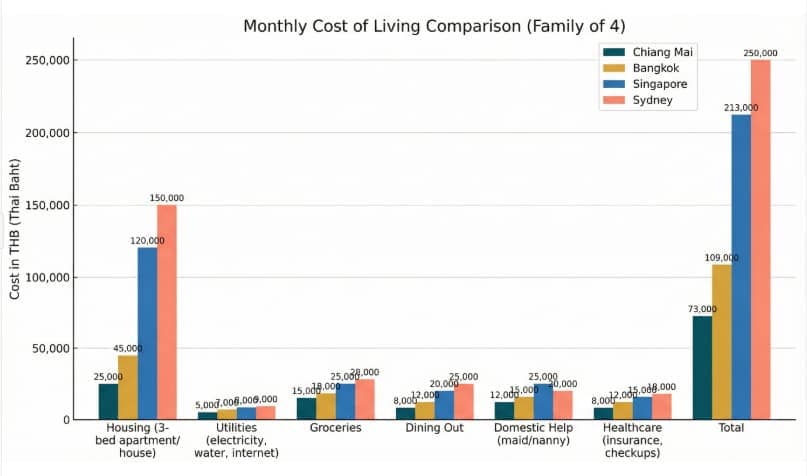
Disposable Income Impact: Chiang Mai families report 35-50% higher disposable income after housing/living costs vs. Bangkok, 70-85% higher vs. Singapore, enabling higher school fee budgets, enrichment activities, or savings.
Expat Community Infrastructure
Support Networks by Area:
| Neighborhood | Expat Density | Parent Groups | International Amenities | School Proximity |
| Nimman | High | 8+ active groups | Organic markets, cafés, gyms | 5-15 min to most schools |
| Hang Dong | Moderate-High | 5+ groups (school-based) | Villa estates, international clinics | Near CMIS, Lanna, Prem |
| Mae Rim | Moderate | 3-4 groups | Rural estates, nature access | Near Prem, Panyadee |
| San Kamphaeng | Low-Moderate | 2-3 groups | Hot springs, local markets | 20-30 min to schools |
| Old City | Moderate | 6+ groups | Cultural sites, restaurants | 10-20 min to most schools |
Community Resources:
- Parent Networks: Chiang Mai Expat Parents (Facebook 12k+ members), InterNations Chiang Mai (3,500+ members)
- School Hosted: Parent associations, family activity days, newcomer orientation sessions
- Enrichment: Music lessons (THB 800-1,500/session), rock climbing (THB 400-600/session), language tutors (THB 600-1,200/hour)
Safety & Healthcare Access
Healthcare Facilities:
| Hospital | Location | Specialties | International Insurance | Pediatric Care |
| Chiang Mai Ram | City Center | General, Emergency | Yes (major providers) | Yes |
| McCormick Hospital | Near Old City | General, Maternity | Yes | Yes |
| Bangkok Hospital Chiang Mai | Hang Dong Road | Full-service, Trauma | Yes (comprehensive) | Yes (24/7) |
| Maharat Nakorn Chiang Mai | University-affiliated | Specialized | Limited | Yes |
Safety Metrics: Thailand ranks 32nd globally on safety index (Numbeo 2026); Chiang Mai specifically reports lower crime rates than Bangkok (violent crime 65% lower per capita).
How To Choose: 5 Decision Checkpoints for School Selection
Choosing the right Chiang Mai international school requires matching educational philosophy, practical logistics, and family priorities across five decision dimensions.
Checkpoint 1: Curriculum & Pedagogy
Curriculum Comparison Matrix:
| Curriculum | Structure | Assessment Style | University Recognition | Best For | Transition Ease |
| British (IGCSE/A-Levels) | Key Stage 1-4, Sixth Form | Exam-focused (external assessments) | UK, Commonwealth, US (with AP supplement) | Structured learners, UK university targets | High (globally standardized) |
| American (US GPA/AP) | Elementary, Middle, High School | Continuous assessment + AP exams | US, Canada, global | Flexible learners, US university targets | High (credit transfer systems) |
| IB Continuum (PYP/MYP/DP) | Ages 3-18, inquiry-based | Internal + external, extended essay | Global (highest recognition) | Critical thinkers, global university targets | Moderate (philosophy shift required) |
| Bilingual (Thai-English) | Varies by school | Mixed | Thai universities, regional | Thai integration, local career paths | Low (curriculum varies significantly) |
| Montessori/Alternative | Child-led, mixed ages | Observation-based | Limited (requires transition) | Self-directed learners, early years | Low (transition to traditional needed) |
Curriculum Decision Framework:
- Target University Region:
- UK → British (IGCSE/A-Levels) or IB
- US → American (AP) or IB
- Australia/Canada → Any (IB has slight edge)
- Thailand/ASEAN → Bilingual or any international
- Learning Style Match:
- Exam-focused, structured → British
- Project-based, flexible → American
- Inquiry-driven, holistic → IB
- Cultural integration → Bilingual
- Transition Risk Assessment:
- High Risk: Montessori→Traditional (grades 6+), Bilingual→International (grades 9+)
- Moderate Risk: American↔British (subject alignment gaps)
- Low Risk: IB↔Any (IB designed for transitions)
Checkpoint 2: Accreditation & University Pathways
Accreditation Bodies & Recognition:
| Accreditation | Full Name | Recognition | Renewal Cycle | Schools in Chiang Mai |
| CIS | Council of International Schools | Global (highest tier) | 5 years | Prem, CMIS, BISC |
| WASC | Western Association of Schools | US-focused, global | 6 years | CMIS, American schools |
| NEASC | New England Association | US-focused | 10 years | Limited presence |
| British Council | UK Government | UK/Commonwealth | 3 years | BISC, British schools |
| MOC/MOEH | Thai Ministry (mandatory) | Thailand only | Annual | All schools |
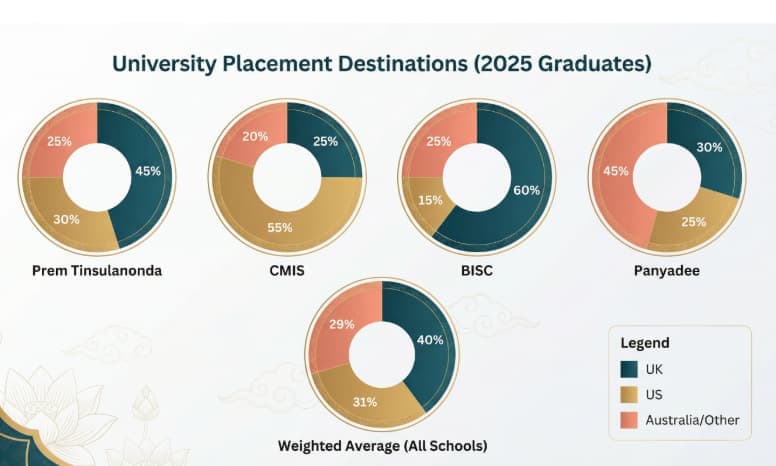
University Placement Metrics (Top Schools, 2025 Graduating Class):
| School | Graduates | UK Universities | US Universities | Australian/Other | Average Scholarship (USD) |
| Prem Tinsulanonda | 85 | 45% | 30% | 25% | 28,000 |
| CMIS | 62 | 25% | 55% | 20% | 22,000 |
| BISC | 48 | 60% | 15% | 25% | 18,000 |
| Panyadee | 35 | 30% | 25% | 45% | 15,000 |
Guidance Counseling Resources:
| Service | Premium Schools | Mid-Tier Schools | Budget Schools |
| Dedicated Counselor Ratio | 1:40-50 | 1:60-80 | 1:100+ (or none) |
| SAT/ACT Prep | Included | Extra fee (THB 15-30k) | Not available |
| UCAS Support | Comprehensive | Basic | Minimal |
| University Visits (Annual) | 20-30+ | 10-15 | 3-5 |
Checkpoint 3: Costs & What’s Included
Total Cost of Ownership (Annual, THB):
| Cost Category | Premium Schools | Mid-Tier Schools | Budget-Friendly | Notes |
| Base Tuition (Grades 9-12) | 550,000-850,000 | 350,000-550,000 | 180,000-350,000 | Varies by grade (lower for elementary) |
| Enrollment/Registration | 80,000-200,000 | 50,000-100,000 | 20,000-50,000 | One-time (sometimes refundable) |
| Capital Levy | 100,000-200,000 | 50,000-100,000 | 0-50,000 | One-time or annual (check policy) |
| Uniforms | 15,000-25,000 | 10,000-18,000 | 5,000-12,000 | Initial purchase |
| Textbooks/Materials | 20,000-40,000 | 15,000-30,000 | 8,000-20,000 | Annual |
| Meals | 25,000-45,000 | 18,000-35,000 | 12,000-25,000 | Annual (if not packed) |
| Transport (Bus) | 45,000-80,000 | 35,000-60,000 | 20,000-40,000 | Annual (route-dependent) |
| Extracurriculars | 30,000-60,000 | 20,000-40,000 | 10,000-25,000 | Annual (sports, arts, clubs) |
| EAL Support (if needed) | 60,000-120,000 | 40,000-80,000 | 20,000-50,000 | Annual (per level) |
| Exam Fees (IGCSE/A-Level/AP/IB) | 40,000-80,000 | 30,000-60,000 | 15,000-40,000 | High school only |
| Total Year 1 | 965,000-1,500,000 | 603,000-973,000 | 290,000-582,000 | Including one-time fees |
| Total Years 2-3 | 785,000-1,200,000 | 523,000-843,000 | 260,000-507,000 | Excluding one-time fees |
3-Year Budget Projection (Mid-Tier School, Grades 6-8):
| Year | Tuition | One-Time Fees | Ongoing Costs | Total Annual | Cumulative |
| Year 1 | 420,000 | 150,000 | 128,000 | 698,000 | 698,000 |
| Year 2 | 441,000 (+5%) | 0 | 134,000 (+5%) | 575,000 | 1,273,000 |
| Year 3 | 463,000 (+5%) | 0 | 141,000 (+5%) | 604,000 | 1,877,000 |
Fee Increase Trends: Chiang Mai schools average 4-7% annual tuition increases (2023-2026 data); budget 5-6% for planning.
Checkpoint 4: Admissions Timeline & Testing
Admissions Process Timeline:
| Timeline | Action | Documents Required | Notes |
| 12 Months Before | Research schools, attend open days | N/A | Priority for popular schools |
| 9 Months Before | Submit applications | Passport copies, previous school records, vaccination records | Application fees THB 3,000-8,000 |
| 6-8 Months Before | Assessments/interviews scheduled | N/A | Grade-appropriate testing |
| 4-6 Months Before | Admission decisions released | N/A | Accept/reject with deposit deadline |
| 2-4 Months Before | Complete enrollment | Deposit payment, medical forms, photo submissions | Secure student visa if needed |
| 1 Month Before | Orientation, uniform fitting, bus registration | N/A | Transition preparation |
Assessment Requirements by Grade:
| Grade Level | Assessment Type | Duration | Preparation Needed |
| Pre-K to Grade 2 | Play-based observation, parent interview | 45-60 min | Minimal (natural behavior) |
| Grades 3-5 | Math, English reading/writing, interview | 90-120 min | Review grade-level basics |
| Grades 6-8 | Math, English, reasoning, student interview | 120-150 min | Practice standardized formats |
| Grades 9-12 | Subject-specific, transcripts, counselor interview | 150-180 min | Prepare transcripts, references |
EAL (English as Additional Language) Support:
- Availability: Most schools offer EAL for non-native speakers
- Cost: THB 40,000-120,000 annually (varies by intensity)
- Assessment: Placement test determines support level
- Duration: Typically 1-3 years until mainstream integration
Checkpoint 5: School Snapshots (2026 Overview)
Comprehensive School Database:
| School | Curriculum | Accreditation | Tuition (Grades 9-12, THB) | Student Count | Student:Teacher Ratio | Boarding | Notable Features |
| Prem Tinsulanonda | IB Continuum | CIS, IB | 680,000-850,000 | 750 | 8:1 | Yes (Grades 7-12) | Highest academic standards, holistic development, strong university placements |
| CMIS | American (AP) | CIS, WASC | 520,000-720,000 | 650 | 10:1 | No | Long-standing (1963), strong extracurriculars, established expat network |
| BISC | British (IGCSE/A-Level) | British Council, CIS | 480,000-680,000 | 520 | 12:1 | No | Traditional British structure, solid pastoral care, UK university focus |
| Panyadee | IB + Bilingual | CIS, IB | 420,000-620,000 | 480 | 10:1 | No | Dual-track (IB + Thai integration), strong Asian university placements |
| Lanna International | British + Bilingual | British Council | 280,000-420,000 | 380 | 14:1 | No | Value-focused, bilingual elements, practical for budget-conscious families |
| Karedes | American + Thai | MOC | 220,000-350,000 | 320 | 15:1 | No | Affordable, local integration, smaller class sizes |
| Montessori International | Montessori | AMI (Montessori) | 180,000-280,000 | 150 | 8:1 | No | Early years focus (Pre-K to Grade 5), child-led learning |
| St. Stephen’s | British + Thai | British Council | 350,000-500,000 | 420 | 13:1 | No | Faith-based, strong arts programs, community focus |
School Selection by Family Profile:
| Family Profile | Recommended Schools | Rationale | Budget Range (Annual) |
| UK University Bound | BISC, Prem, Lanna | British curriculum alignment, UCAS support | THB 350,000-850,000 |
| US University Bound | CMIS, Prem | AP offerings, SAT prep, US counselor networks | THB 520,000-850,000 |
| Global/Undecided | Prem, Panyadee | IB flexibility, highest transfer ease | THB 420,000-850,000 |
| Budget-Conscious | Lanna, Karedes, Montessori | Quality education at lower cost | THB 180,000-420,000 |
| Thai Integration | Panyadee, Lanna, Karedes | Bilingual programs, local cultural exposure | THB 220,000-620,000 |
| Boarding Needed | Prem | Only school with boarding (Grades 7-12) | THB 680,000-850,000 |
| Early Years Focus | Montessori, Prem PYP | Child-led, inquiry-based early education | THB 180,000-450,000 |
Logistics: Commute, Housing & After-School Considerations
Neighborhood Housing Matrix by School Catchment
| School | Nearby Neighborhoods | Avg. Rent (3-Bed, THB/month) | Commute Time | Bus Available | Family Amenities |
| Prem | Mae Rim, Hang Dong North | 35,000-60,000 | 10-20 min | Yes | Nature access, estates |
| CMIS | Hang Dong, San Sai | 30,000-55,000 | 15-25 min | Yes | International clinics, markets |
| BISC | Nimman, Old City | 35,000-65,000 | 10-20 min | Yes | Cafés, gyms, hospitals |
| Panyadee | Hang Dong, Mae Rim | 30,000-55,000 | 15-25 min | Yes | Villa estates, parks |
| Lanna | San Kamphaeng, East | 25,000-45,000 | 20-30 min | Limited | Local markets, hot springs |
After-School & Holiday Care
| Service | Availability | Cost (THB) | Notes |
| After-School Care | Most schools (until 5-6pm) | 5,000-15,000/month | Essential for working parents |
| Holiday Programs | School breaks (summer, Christmas, Easter) | 8,000-25,000/week | Camps, activities, excursions |
| Sports Clubs | External + school-based | 3,000-8,000/month | Football, swimming, martial arts |
| Arts/Music | External tutors + school programs | 800-1,500/session | Private or group lessons |
Conclusion
Choosing the most suitable international school in Chiang Mai is not just about curriculum or cost, it’s about finding an environment that supports your child’s full development, both academically and personally. With multiple pathways available, from British and American to IB and bilingual models, families must carefully align their decision with long-term goals, learning style, and lifestyle preferences in Chiang Mai.
At Panyaden International School, we understand that education goes beyond academics. As one of the leading holistic schools in the region, we integrate internationally recognized curricula with values-based learning rooted in mindfulness, sustainability, and emotional development. For families exploring Chiang Mai’s international schools, choosing a school like Panyaden ensures your child grows not only in knowledge, but also in character, resilience, and global awareness.
Frequently Asked Questions (FAQs)
1. How do I choose the right international school in Chiang Mai?
Start by identifying your child’s future university goals and preferred learning style. Then shortlist schools that match your curriculum preference, budget, and location. Visiting campuses and speaking with current parents can also help validate your decision.
2. What is the best curriculum for international students?
There is no single “best” curriculum. IB is ideal for global flexibility, British works well for UK pathways, and American suits US university routes. The right choice depends on your child’s long-term academic direction.
3. How early should I apply to international schools?
It’s recommended to apply at least 9–12 months in advance, especially for competitive schools or higher grade levels where seats are limited.
4. What additional costs should parents expect beyond tuition?
In addition to tuition, parents should budget for enrollment fees, uniforms, transport, meals, extracurricular activities, and possible English language support programs.
5. How does the burning season affect students?
During February to April, air quality can impact outdoor activities. Most schools implement indoor alternatives and air filtration systems, and families often plan travel during this period.
6. Are there schools that focus on holistic or values-based education?
Yes, some schools in Chiang Mai emphasize holistic development, combining academics with emotional wellbeing, mindfulness, and sustainability, providing a more balanced educational experience.


0